
Decision Guide
Should You Repair or Replace Your Water Heater?
The right call depends on the age of the unit, what actually failed, and how that fault fits into the equipment's remaining service life. This page walks through the framework rather than a single rule of thumb, because the honest answer is usually 'it depends on which of these applies to you.'
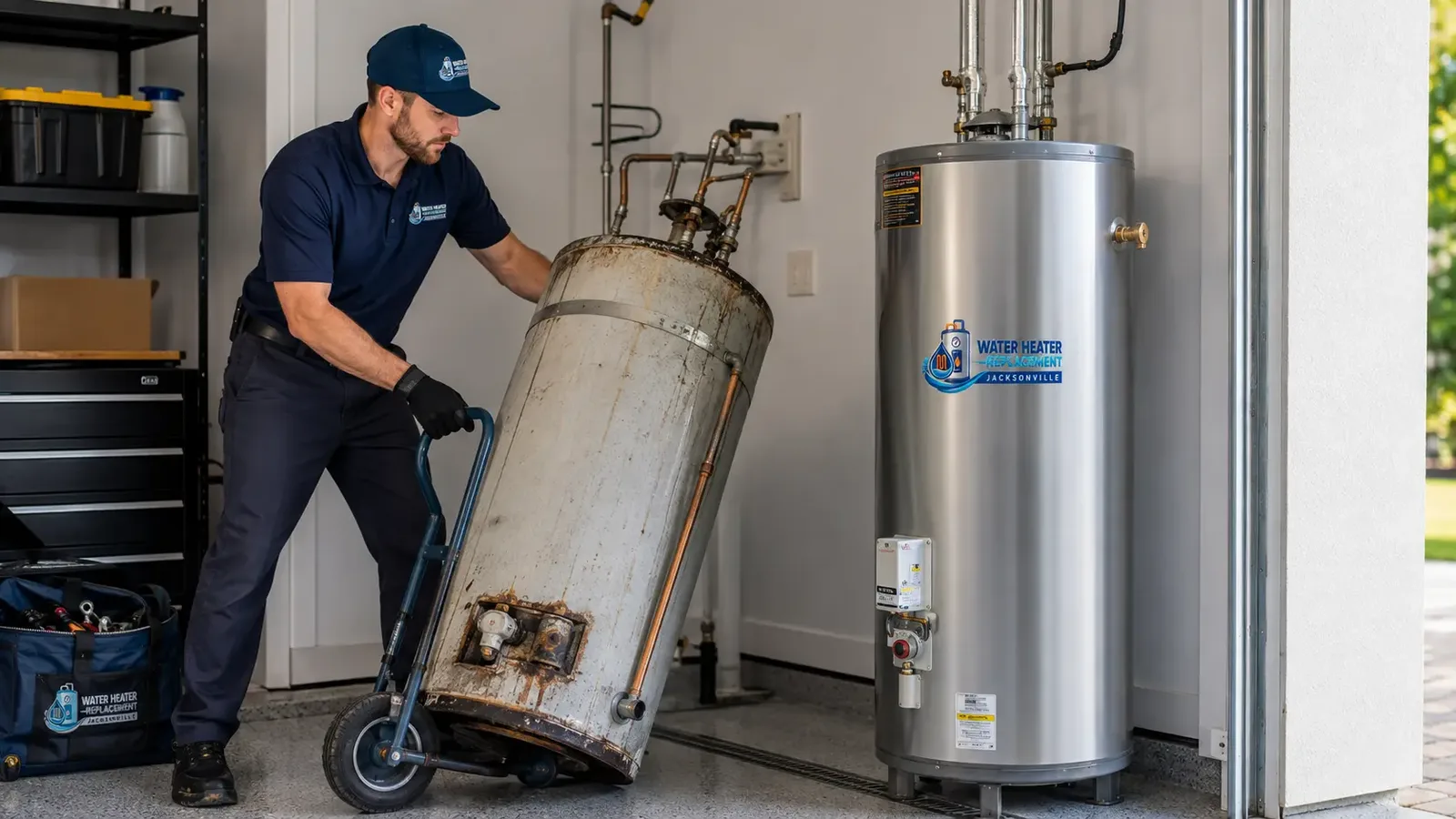
The framework
Three questions to ask before deciding
Every repair-or-replace decision comes down to three questions asked together, not in isolation: how old is the unit, what specifically failed, and what would it cost to fix that fault relative to what a full replacement would cost. A young unit with an isolated, inexpensive fault is an easy repair call. An old unit with a fault that touches the tank itself is an easy replacement call. Most real situations fall somewhere between those two extremes, which is exactly where a clear framework matters most.
Age thresholds
Standard tank water heaters in Northeast Florida commonly reach roughly eight to twelve years of service life, with mineral content in the water supply and sediment buildup at the bottom of the tank being the main forces that shorten it. Under about six years, a repair is usually worth pursuing for most faults, since the unit should have years of useful life left and the investment in a repair has time to pay off. Between roughly six and ten years, the decision gets more situational and depends heavily on which component failed. Past ten to twelve years, most faults tip toward replacement, because even a successful repair is being performed on a tank that is approaching or past its expected lifespan, and a second failure soon after is a real possibility. Tankless units often have a longer expected lifespan when maintained, which shifts these thresholds later, but the same logic of weighing remaining service life against repair cost still applies.
Fault types that are usually repairable
Some failures are isolated to a single replaceable component and do not indicate that the tank or heat exchanger itself is compromised. A failed heating element or thermostat on an electric tank, a faulty thermocouple or igniter on a gas unit, a bad gas valve, a tripped high-limit switch, a failed pressure relief valve, or sediment causing reduced performance are all commonly repairable, particularly on a unit under roughly six to eight years old. These faults share a common trait: they are components bolted to or threaded into the tank rather than failures of the tank or heat exchanger itself, so replacing the part restores the unit without addressing a shell that is already compromised.
Fault types that are usually terminal
Other failures indicate that the core of the unit itself has reached the end of its life, and no repair meaningfully extends that. Any water leaking from the tank body itself, rather than from a fitting or valve that can be tightened or replaced, means the tank shell has been breached by internal corrosion and cannot be repaired; the tank must be replaced. Rusty water coming from the hot tap across multiple fixtures, rather than a single fixture with its own issue, often points to internal tank corrosion. A tankless heat exchanger with a cracked or corroded core is a similarly terminal fault. Popping or rumbling noises alone are not necessarily terminal, since that is often sediment rather than tank failure, but combined with age past eight to ten years, it is a signal worth taking seriously rather than dismissing as cosmetic.
Cost-versus-age reasoning
A useful rule many homeowners find practical: if the cost of a repair exceeds roughly half of what a full replacement would cost, and the unit is more than halfway through its expected service life, replacement is usually the better financial decision, because you are paying a large fraction of a new system's price for equipment that still carries the risk of a second failure soon after. On the other hand, a modest-cost repair, such as a single heating element or a thermocouple, on a unit that is only a few years old is rarely worth second-guessing; it is the far cheaper and entirely reasonable choice.
The risk of deferring a needed replacement
Delaying a replacement that is genuinely needed carries risk beyond simple inconvenience. A tank with a compromised shell can progress from a slow drip to a more significant leak without much warning, and water damage to flooring, drywall, or items stored nearby can cost far more to remediate than the replacement itself would have. A unit installed in an attic or a second-floor closet carries that risk to the ceiling and rooms below. Deferring also removes your ability to plan: a replacement handled on your own schedule allows you to compare options and prepare the space, while a failure forces a same-day or emergency decision under time pressure. If your unit is showing multiple signs at once, age past ten years, rust at the tap, and rumbling, treating that combination as a planning trigger rather than waiting for an outright failure is usually the better position to be in.
| Factor | Lean toward repair | Lean toward replace |
|---|---|---|
| Unit age | Under roughly 6–8 years | Past roughly 10–12 years |
| Fault location | Element, thermostat, thermocouple, valve, igniter | Tank shell leak, internal corrosion, cracked heat exchanger |
| Repair cost relative to replacement | A modest fraction of full replacement cost | Roughly half or more of full replacement cost |
| Water quality symptoms | Isolated to one fixture, likely fixture-side | Rust or discoloration across multiple hot taps |
| Risk if deferred | Low; component-level fault only | Meaningful; possible water damage from tank failure |
This page is a general decision framework, not a diagnosis. A technician confirming the actual condition of your specific unit, including tank integrity, is the only reliable way to know which side of this framework your situation falls on.
Next step
If replacement is the answer
Ready to talk about a replacement?
Share your current system, capacity, installation location and what is happening now. We will follow up to confirm scope and provide an estimate for your property.