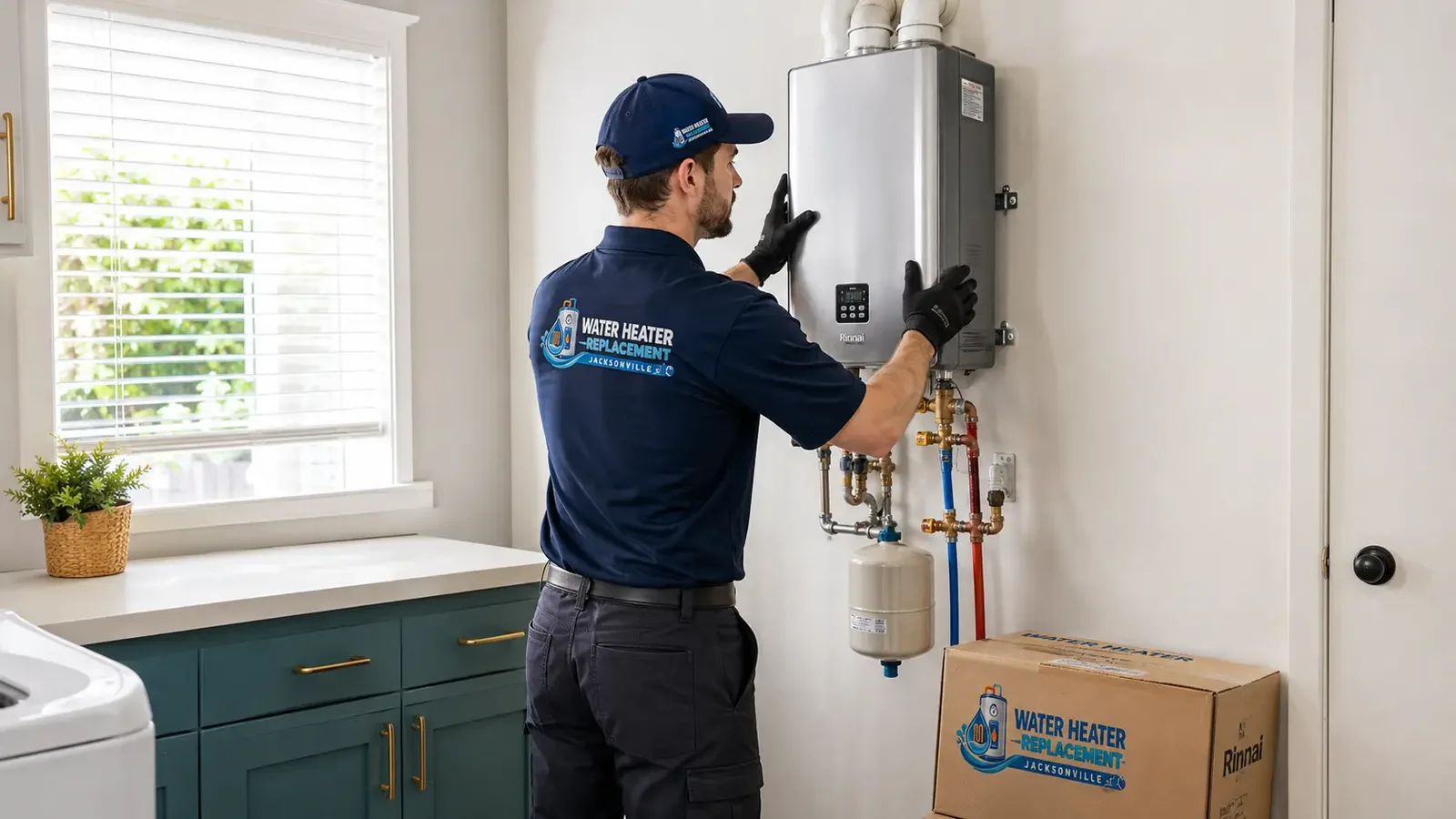
What tankless installation covers
A tankless, or on-demand, water heater does not store a large volume of preheated water. Instead, a heat exchanger warms water as it passes through, activated by flow when a hot tap opens. This service covers two situations: converting a Jacksonville home from an existing storage tank to a tankless unit, and replacing an existing tankless unit that has reached the end of its life. The two projects share the same equipment but differ in scope, since a conversion introduces infrastructure that a straight tankless-to-tankless replacement already has in place.
If you are not yet sure tankless is the right direction, the tank vs tankless comparison lays out the trade-offs independent of any specific project, and the tank replacement page covers the simpler alternative of staying with a storage system.
When tankless is the right fit
Tankless installation makes the most sense for households with long-term plans to stay in the home, who want continuous hot water rather than a fixed reserve, or who need to reclaim floor space in a garage or closet. It is also a natural fit when an existing tank has failed and the household has already been considering the switch, since the old unit needs to come out regardless. It is a weaker fit for anyone who needs the lowest-disruption replacement possible, since the conversion work is inherently more involved than a like-for-like tank swap.
How the work is sequenced
Installation begins with an assessment of what the conversion actually requires: for gas units, the diameter and length of the existing gas line versus what the new unit demands at full fire, and the venting category needed for the specific model. For electric tankless units, the assessment centers on available panel capacity, since whole-house electric tankless heaters draw significantly more amperage at startup than a standard tank element ever does. Both paths also require confirming a mounting location with a short, direct path for venting or adequate clearance for electrical conduit.
Once those requirements are confirmed, the old tank, if present, is drained and removed, and the space is prepared for the wall-mounted unit: bracket installation, water line adjustments since tankless connections sit differently than a tank's top connections, and the actual gas line upsizing or electrical circuit work if the assessment called for it. Venting is then run, whether that is a short run through an exterior wall for a garage-mounted unit or a longer run for an interior installation. The system is purged, powered, and tested across multiple fixtures at once to confirm flow rate and temperature hold under simultaneous demand, which is the real test of whether sizing was correct.
Jacksonville-specific conditions that affect this project
Garage-mounted tankless installations are common in Jacksonville because garages already have exterior-facing walls that make venting straightforward, and because many Southside homes, including those in Baymeadows and Southpoint, were built with the water heater in the garage to begin with. Humidity is less of a direct threat to a tankless unit's electronics than it is to a tank's steel shell, but exterior venting terminations still need correct clearance from windows, soffits, and mechanical intakes, which matters on the tighter lot lines found in some Lakewood and Englewood properties.
Mineral content in the water supply is the other major local factor. Scale accumulates inside a tankless heat exchanger over time in exactly the way sediment accumulates at the bottom of a tank, and without periodic descaling that scale reduces efficiency and can eventually damage the exchanger. This is a maintenance point worth planning for at installation, since some units are set up with isolation valves specifically to make descaling straightforward, and adding those valves during the initial installation is far simpler than retrofitting them later.
What changes scope or cost
The biggest cost driver in a conversion is whether the existing gas line has to be upsized, since that can mean running new pipe from the meter or a nearby branch rather than simply connecting at the old tank's stub-out. Electrical capacity is the equivalent driver for electric tankless units. Venting material and run length matter for gas units regardless of fuel line size. A straight tankless-to-tankless replacement avoids most of this and is much closer in cost and time to a tank swap. The cost calculator separates these scenarios so you can see where your project likely falls.
How to prepare
Know your current fuel type and, if possible, the diameter of the gas line feeding your water heater location, since that single detail often determines whether a conversion is straightforward or requires additional plumbing. Clear access to the intended mounting wall, and if you are unsure what capacity your household needs under simultaneous demand, review the sizing guide before the visit so flow-rate expectations are set correctly from the start.