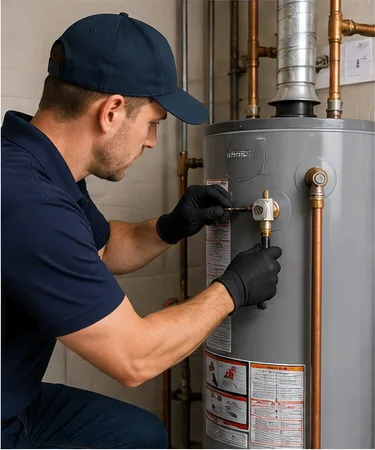
Riverside is one of Jacksonville's oldest residential neighborhoods, stretching from the St. Johns River past the Cummer Museum area and Memorial Park, up through Five Points and out along Park Street and King Street. The housing stock reflects a century of building and rebuilding: original bungalows and two-story frame houses, homes that were divided into duplexes decades ago, apartment buildings from several eras, properties that have been fully renovated down to the studs, and newer infill construction on lots that opened up along the way. When a water heater fails in Riverside, the practical question is rarely just "which unit do I buy" — it is how the replacement fits the specific house it is going into. A tank that slides easily into a 2015 garage may not clear the door of a 1926 utility closet, and connections that were standard when the last unit went in may not be what a new installation calls for today.
Water heater replacement in Riverside homes
Most Riverside water heaters live in one of three places: a dedicated interior closet, a detached or tuck-under garage, or a rear utility room or enclosed porch that was added at some point in the home's life. Each has its own quirks. Interior closets in older houses were sized for the equipment of their day, and the clearances around them are often just a few inches. Utility rooms added onto the back of a house may have shorter ceiling heights than the main structure. Garages behind Riverside homes are frequently detached or narrow, which affects both the run of the hot water line and how easily equipment can be carried in and out.
Renovated properties are a different story again. A house near Riverside Arts Market that was taken back to the frame in the last decade may have modern supply lines, an updated panel, and a purpose-built mechanical space — which makes a straightforward replacement or even a tankless conversion much simpler. Two houses on the same block can therefore call for two very different approaches, which is why an evaluation of what is actually there matters more here than in a uniformly built subdivision.
Aging connections and older infrastructure
In homes that have not been substantially updated, the connections around the water heater are frequently older than the heater itself. Shutoff valves that have not been turned in fifteen years may not seat properly once they are moved. Supply lines can be a mix of materials from different repair eras. On the electric side, the circuit feeding an older unit may be adequate for a like-for-like swap but worth verifying before a larger or different type of unit is installed. On the gas side, the existing venting path in an older structure needs to be checked rather than assumed. None of this is unusual for a neighborhood of Riverside's age — it simply means the replacement scope is best confirmed before equipment is ordered.
Signs your water heater may need replacement
Water pooling under the tank or rust-colored staining on the base is the clearest signal, and once a tank itself is leaking, replacement is generally the path forward rather than repair. Other indications are less dramatic: hot water that runs out noticeably faster than it used to, rusty or metallic-smelling hot water, rumbling or popping sounds as sediment shifts on the tank bottom, recurring pilot or heating element problems, or a unit that has simply passed the age range where continued repair makes financial sense. If you are weighing one more repair against a replacement, our repair-or-replace comparison walks through the trade-offs.
Tank and tankless options
Neither format is automatically the right answer for a Riverside home. A conventional tank is predictable, generally less expensive to install, works with the venting and supply already in place, and handles a household's normal draw without needing anything changed. That is often the practical choice in a historic home where altering the structure is undesirable or where the utility space is small.
A tankless unit frees up floor area, provides continuous hot water rather than a fixed reserve, and typically has a longer service life. Those advantages are real, but they depend on the house being able to support the installation: adequate gas supply and a workable vent route for gas models, or sufficient electrical capacity for electric ones. In a renovated Riverside property that already has updated systems, that hurdle is often already cleared. Our tank versus tankless breakdown covers the comparison in more detail, and the sizing guide helps match capacity to how many bathrooms and people the system serves.
Replacement considerations specific to Riverside
A few things come up repeatedly in this part of Jacksonville. Dimensions are the first: measure the space, not just the old tank's capacity label, because a modern equivalent may not be the same physical size. Access is the second — homes on the narrow streets around Five Points and Memorial Park often have limited driveway space and a long carry from the curb, and interior stairs or original flooring need protecting on the way through.
Drainage is a third consideration. An interior closet installation on an upper floor or over finished space is a candidate for a drain pan and a discharge line routed somewhere sensible, which is not always how a decades-old installation was left. Finally, in divided or multi-unit properties, it is worth confirming exactly which fixtures the unit serves before choosing capacity, since assumptions about a converted floor plan are easy to get wrong.
Our replacement process
- Evaluate the existing equipment. Fuel type, capacity, age, condition of the connections, and where the unit sits in the house.
- Discuss replacement choices. Tank or tankless, capacity, and what the space and existing systems realistically support.
- Confirm installation requirements. Clearances, shutoffs, venting, discharge line, expansion tank and drain pan where applicable.
- Remove the old unit. Drained fully and carried out along a protected path.
- Install the replacement. New connections where the old ones are not sound, set level and secured.
- Test the system. Check for leaks, confirm heating operation and set the temperature.
- Clean the work area. Old equipment hauled away and the space left as it was found.
Nearby areas we serve
Riverside sits close to several other neighborhoods we cover. Across the river, San Marco shares a similar mix of historic houses and renovated properties. Lakewood and Arlington lean more toward mid-century and ranch-style construction, while Mandarin covers a broader spread of suburban housing to the south. The full list is on our service areas page.