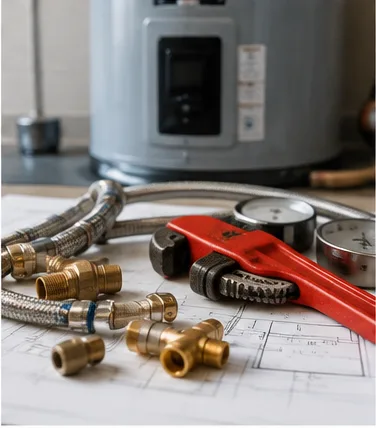
Jacksonville Beach occupies the strip between the Intracoastal Waterway and the Atlantic, running from the streets around the Jacksonville Beach Pier and Oceanfront Park down 3rd Street and A1A, and inland along Beach Boulevard. The housing is a genuine mix: original beach cottages on small lots, mid-rise and low-rise condominiums, townhomes, homes that serve as vacation or second properties, and newer coastal construction built to current standards. Water heater replacement here has two recurring themes. The first is space — beach houses and condos tend to have compact utility areas where equipment dimensions genuinely matter. The second is environment: constant humidity and coastal air are worth accounting for honestly, without turning them into a scare story.
Water heater replacement in coastal homes
Most units here sit in a garage, a ground-level enclosure, a small utility closet, or a laundry alcove. In older cottages those spaces were built around whatever equipment existed at the time, so a modern tank of the same nominal capacity may not slot into the same footprint. Measuring the space, the door opening and the clearance above the unit is a first step rather than an afterthought.
Condominium and townhome installations add a coordination layer. Access to the unit, elevator or stairwell use for moving equipment, exterior wall penetrations for venting, and notice requirements are frequently governed by the association. None of that changes the mechanical work, but it does change how a replacement gets scheduled — and it is much easier to sort out before installation day than during it.
Humidity, coastal air and corrosion, described accurately
Salt-laden air does not destroy water heaters. What it can do, gradually, is accelerate surface corrosion on exposed metal that is regularly in contact with humid outdoor air: fittings and connectors, strapping and brackets, vent terminations, and exterior-facing equipment. Indoors, persistent humidity in a closed, poorly ventilated utility room keeps moisture against the tank jacket and the base, which over years is not helpful.
The sensible response is practical rather than dramatic. Give the equipment ventilation where you can. Look at the exposed metal occasionally — connections, the tank base, any vent termination outside — and address surface corrosion before it becomes a leak. During a replacement, connections and shutoffs in visibly deteriorated condition should be renewed rather than reused. Beyond that, a coastal water heater is subject to the same fundamentals as any other: internal sediment, anode rod wear, and the age of the tank.
Signs your water heater may need replacement
Standing water or dampness under the unit is the decisive one — a leaking tank is not repairable. Rust-colored hot water, a shrinking supply of hot water, popping or rumbling from sediment, a relief valve that keeps discharging, and repeated component failures all point in the same direction as a unit ages. In second homes there is an additional concern: a small leak with nobody in residence can run for weeks. If a property is left empty for stretches, shutting off the water supply when you leave, or fitting a leak detection device, is worth considering. Our repair or replace guide covers where the line usually falls.
Tank and tankless options
Tank water heaters remain a reliable, cost-effective choice here, especially where the existing connections and space suit them and the household wants the simplest possible replacement. Stored capacity handles a busy morning without needing high sustained input.
Tankless has particular appeal at the beach for space reasons. A wall-mounted unit reclaims a closet or floor corner in a cottage or condo where every square foot is accounted for, and it does not hold a standing reserve of hot water in a property that may go unused for weeks. It has to be justified by the installation, though: gas models need adequate supply and a proper vent route, which in a condo means clearing exterior penetrations with the association, and electric models need sufficient service capacity. Neither format is universally the right call — see the side-by-side comparison and the tankless installation details.
Replacement considerations specific to Jacksonville Beach
Space planning comes first: compact utility areas mean physical dimensions, door swing and the carry path all need checking before equipment is ordered. Second is ventilation — where the unit lives in a tight, closed space, improving airflow benefits the equipment and, for gas appliances, correct combustion air and venting are requirements, not preferences.
Third is the seasonal-occupancy factor. Vacation and second homes should be set up for intermittent use, which may mean a lower standby setting when the property is empty and a plan for shutting off supply between visits. Fourth is condo coordination, covered above. And fifth, given the humidity, is a slightly more attentive habit of inspecting exposed connections over the life of the equipment.
Our replacement process
- Evaluate the existing equipment. Type, age, capacity, location and the condition of exposed connections and fittings.
- Discuss replacement choices. Whether a compact tank or a wall-mounted tankless unit better suits the space and how the property is used.
- Confirm installation requirements. Clearances, venting, shutoffs, drainage and any association requirements for condo properties.
- Remove the old unit. Drained and carried out along a protected route.
- Install the replacement. Deteriorated connections renewed rather than reused, unit set level and secured.
- Test the system. Leak check, heating confirmed, temperature set appropriately for the occupancy pattern.
- Clean the work area. Old equipment removed from the property.
Nearby areas we serve
Heading inland along Beach Boulevard and Butler Boulevard, we also cover Arlington, Deerwood, Baymeadows and Southpoint, where condo and townhome installations raise some of the same space questions found at the beach. The complete list is on the service areas page.