The Baymeadows corridor grew up along Baymeadows Road between I-95 and Southside Boulevard, filling in steadily from the late 1970s through the 2000s. The result is a patchwork rather than a single housing type: detached homes in planned subdivisions, rows of attached townhomes, low-rise condominium buildings, and apartment communities converted to individual ownership. For water heater replacement that variety matters more than the age of any one building. A detached house with a two-car garage and a slab-level utility area is a completely different job from a second-floor condominium closet reached through a shared stairwell, even though the two may be a quarter mile apart and the same age.
Water heater replacement across Baymeadows housing types
In detached subdivision homes, the unit typically sits in the garage or an adjacent utility space. These are the most straightforward replacements — open access from the driveway, room to maneuver, and a slab floor where a pan and discharge line are simple to accommodate. Two-story homes in this category sometimes place the heater in an upstairs closet instead, usually to shorten the run to the main bathrooms, and that changes the calculation considerably.
Townhomes and condominiums usually put the water heater in an interior closet, a laundry alcove, or occasionally a mechanical space shared with the HVAC air handler. Space is the constraint. Those closets were dimensioned for the original equipment, and a modern tank of the same nominal capacity may be an inch or two larger in every direction because of thicker insulation. Confirming that a replacement will actually fit — and that the door still closes — is a routine part of scoping these installations.
Access, scheduling, and shared buildings
Attached and multi-unit properties add logistics that a detached home does not have. Getting a full-size tank up an exterior stairwell, protecting shared hallways and landings, parking within reach of the unit, and shutting off water in a way that does not surprise a neighbor all need planning ahead of the appointment. Many Baymeadows communities also have their own contractor rules. We work within whatever the association requires; the important part is knowing about it before the truck is loaded rather than at the front gate.
Signs your water heater may need replacement
Pooled water or rust staining at the base means the tank has likely failed and replacement is the realistic answer. Short of that, watch for hot water that runs out earlier than it used to, rust-colored or metallic-tasting hot water, rumbling from sediment shifting on the tank floor, repeated element or pilot issues, or a unit that has simply reached an age where another repair is throwing money at a finite lifespan. In a condo or townhome there is one more reason to act early: a leak in an upper-floor closet reaches a neighbor's ceiling, not just your own floor. Our repair-or-replace comparison covers the decision in detail.
Tank and tankless options in Baymeadows
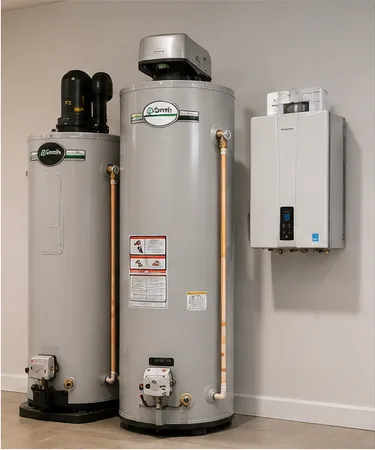
Conventional tanks handle the majority of Baymeadows households well. They reuse the existing venting and connections, cost less to install, and a 40- or 50-gallon reserve suits a two- or three-bathroom home with typical usage. Where the current unit has served the property adequately, a like-for-like replacement is usually the shortest and least disruptive route.
Tankless has a specific appeal here because floor space in a townhome or condo closet is genuinely valuable, and a wall-mounted unit frees it. The constraints are structural: a gas model needs adequate supply and a vent route that works in an attached building, and an electric model needs sufficient service capacity. Both are answerable, but only after looking at the actual unit. Our tank versus tankless comparison explains the trade-offs, and the sizing guide helps match capacity to how the household actually uses hot water.
Replacement considerations specific to Baymeadows
Drainage protection ranks first, because so many installations here are inside living space or above another unit. A pan with a discharge line routed to a sensible termination point is the difference between a nuisance and a claim. Many original installations were left without one.
Long hot water runs are second. Two-story homes and stretched floor plans put the farthest bathroom well away from the heater, and the resulting wait for hot water gets blamed on the unit's capacity when it is really a distribution issue. Distinguishing between the two before choosing a replacement saves buying capacity that will not solve the complaint.
System pressure is third. Where a pressure-reducing valve or backflow device creates a closed system, thermal expansion has nowhere to go, and an expansion tank belongs in the installation. That gets confirmed on site rather than assumed either way.
Our replacement process
- Evaluate the existing equipment. Fuel type, capacity, age, condition of the connections, and where the unit sits within the building.
- Discuss replacement choices. Tank or tankless, capacity, and what the space and existing systems realistically support.
- Confirm installation requirements. Clearances, shutoffs, venting, discharge line, expansion tank and drain pan where applicable.
- Plan access. Carry path, parking, and any community access rules that apply to the property.
- Remove the old unit. Drained fully and carried out along a protected path.
- Install the replacement. New connections where the old ones are not sound, set level and secured.
- Test and clean up. Check for leaks, confirm heating and temperature, haul away the old equipment.
Nearby areas we serve
Baymeadows connects to several neighborhoods we cover. Deerwood sits just east with larger homes and higher simultaneous demand, Southpoint to the northeast has a comparable mix of condos and townhomes, and Lakewood and Mandarin lie west and south. See the full list on our service areas page.