
Sizing
Water Heater Sizing Guide for Jacksonville Homes
Sizing a water heater correctly is the difference between a system that keeps up with a household and one that runs out of hot water every morning. This guide walks through the numbers that matter for tank and tankless equipment, then the size planner below gives you a starting category for your own home.
The fundamentals
Two different sizing questions: tank capacity and tankless flow rate
"What size water heater do I need" is really two different questions depending on the type of equipment you are considering. For a storage tank, the question is how many gallons of hot water the tank can deliver in a burst of use, and how quickly it recovers afterward. For a tankless unit, there is no stored volume at all; the question becomes how many gallons per minute the unit can heat to a usable temperature at the same time, which depends on the incoming water temperature. Both approaches are trying to answer the same underlying problem, matching equipment to a household's actual hot water demand, but the vocabulary and the numbers involved are different enough that they are worth explaining separately.
First-hour rating for tank water heaters
A tank's nameplate capacity, such as 40 or 50 gallons, is not the same as how much hot water it can actually deliver during a busy hour. The first-hour rating (FHR) combines the stored volume with the recovery rate to describe how many gallons of hot water the unit can supply in one hour, starting from a full tank, before running out. A 50-gallon tank with a fast-recovery gas burner can have a meaningfully higher first-hour rating than a 50-gallon electric tank with two standard elements, because gas typically recovers faster than electric resistance heating. This is why comparing two tanks by stored gallons alone can be misleading: the FHR on the equipment's spec sheet is the number that actually predicts whether a household will run out of hot water during a morning rush.
Recovery rate
Recovery rate describes how many gallons per hour a tank can reheat after hot water has been drawn out. It matters most in households with back-to-back draws, such as two showers in close succession or a shower running at the same time as a load of laundry. A tank with strong stored capacity but a slow recovery rate can still leave a household waiting if usage is spread through the day faster than the unit can catch up, particularly with electric tanks, which generally recover more slowly than gas.
Tankless GPM and temperature rise
Tankless units are rated by how many gallons per minute they can heat to a target output temperature, and that rating always depends on the temperature rise required, meaning the difference between the incoming groundwater temperature and the desired output temperature. Because Jacksonville's groundwater is relatively warm compared to colder climates, a given tankless unit can typically deliver a higher usable flow rate here than the same model would in a northern state, since it has less of a temperature gap to close. That is a genuine local advantage, but it does not eliminate the need to size for actual simultaneous demand: a unit that comfortably handles one shower may fall short the moment a second shower and a dishwasher run at once, because the total flow requested exceeds what the unit can heat to full temperature at that flow rate. Sizing tankless equipment means adding up the flow rate of fixtures likely to run at the same time, not just the single largest fixture in the house.
Household size and bathroom count
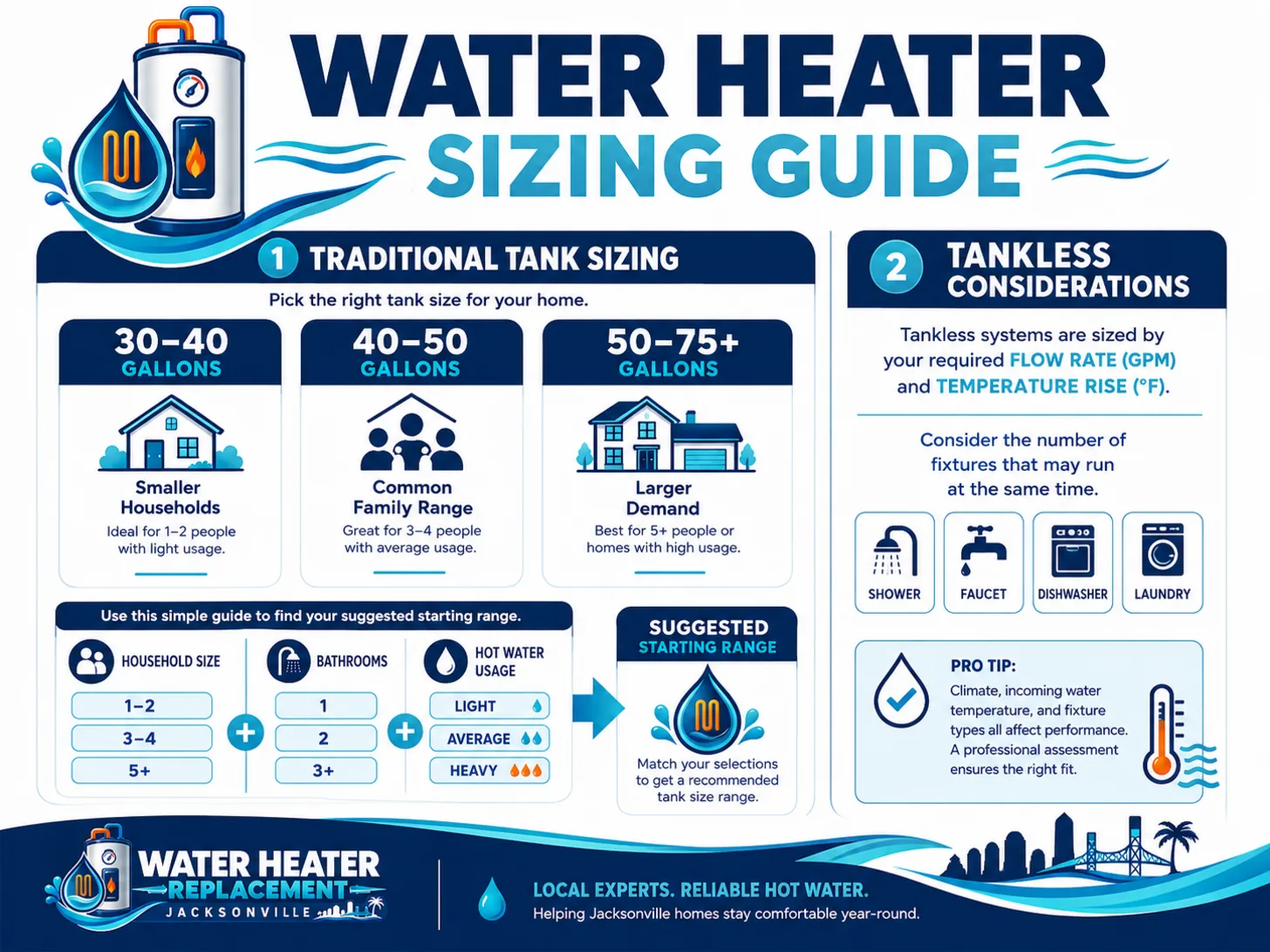
Household size and bathroom count are useful starting points because they correlate with both peak demand and how much overlapping use is likely. A single person or couple with one bathroom rarely creates simultaneous demand, so a smaller tank or a modest tankless unit is usually adequate. A household of four or five with two or more bathrooms introduces a much higher chance of overlapping showers, laundry, and dishwasher cycles, which pushes toward either a larger stored capacity, a faster recovery rate, or a higher-GPM tankless unit. The size planner inside the calculator below asks for household size, bathroom count, and how often fixtures tend to overlap, then maps those answers to a capacity or flow-rate band.
Oversizing versus undersizing
Undersizing is the more familiar problem: cold showers, a dishwasher that never gets hot water, a tankless unit that throttles output when demand spikes. It is also the failure mode most people are trying to avoid when they size up "to be safe." But oversizing has real costs too. A tank that is much larger than the household needs keeps more standby water heated around the clock, which increases operating cost over the life of the unit for no functional benefit. An oversized tankless unit sized for demand the house never actually generates is simply a larger up-front expense with no corresponding gain. The goal is a reasonably tight match to real usage patterns, informed by first-hour rating or GPM at the temperature rise your home actually needs, not the largest unit that will fit in the space.
Reference
Household size guidance
General starting points. The calculator below refines this using bathroom count and how often use overlaps.
| Factor | Typical tank range | Typical tankless flow |
|---|---|---|
| 1–2 people, 1 bathroom | 30–40 gallon range | Roughly 4–6 GPM capability |
| 3–4 people, 1.5–2 bathrooms | 40–50 gallon range | Roughly 6–8 GPM capability |
| 4–5 people, 2–3 bathrooms, frequent overlap | 50–65 gallon range | Roughly 8–10 GPM capability |
| 5+ people or heavy simultaneous use | 65+ gallon range, or higher-recovery equipment | 10+ GPM, sometimes requiring multiple units |
This is general planning guidance, not a substitute for professional sizing. Actual requirements depend on fixtures, usage patterns, incoming water temperature and equipment specifications. Use the planner below for a household-specific starting point.
Interactive tool
Get a sizing starting point for your household
Switch to the size planner tab to enter household size, bathrooms, and overlapping-use patterns.
Jacksonville Water Heater Replacement Calculator
Two planning tools in one place: a replacement cost planner for budgeting and a size planner for matching capacity to household demand.
Estimated planning range
Standard tank replacement
$1,150 – $2,750
Tankless installation
$3,200 – $6,650
Major factors affecting this estimate
- Garage placement is usually the most straightforward access, which tends to keep labor scope predictable.
- Condition of existing shutoff valves, flex connectors, the temperature and pressure relief discharge line and the drain pan.
- Permit and inspection requirements, plus any corrections needed to bring the installation into compliance.
Recommended next step
Compare both ranges alongside your household hot-water demand, then request an estimate so the actual installation conditions can be reviewed.
Planning estimate only. Actual pricing depends on equipment, installation conditions, access, connections, venting, electrical or gas requirements, permits and other site-specific factors.
Keep planning
Related resources
Tank vs Tankless
Repair or Replace
Replacement services
Ready to talk about a replacement?
Share your current system, capacity, installation location and what is happening now. We will follow up to confirm scope and provide an estimate for your property.