
Comparison
Tank vs Tankless Water Heater: Which Fits Your Jacksonville Home?
Both types are legitimate, well-proven choices. The right one depends on your existing gas or electrical capacity, how your household uses hot water, your budget horizon, and how long you plan to own the home.
Overview
How each type actually works in a house
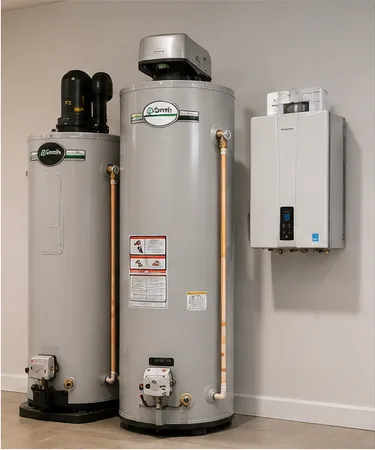
A storage tank water heater keeps a set volume of water, commonly 30 to 55-plus gallons in residential settings, heated and ready at all times. When a fixture calls for hot water, it draws from that stored volume, and the tank reheats what was used, either continuously in the background or as demand comes in. This is the technology most Jacksonville homes were built with, and it remains the default choice for a straightforward like-for-like replacement because the existing connections, venting, and electrical or gas supply are usually already sized correctly for it.
A tankless water heater has no stored volume at all. Cold water enters the unit, passes through a heat exchanger, and comes out at the target temperature, all within the length of the fixture run. Because there is no tank to run out of, tankless systems can supply hot water for as long as the demand stays within the unit's flow-rate capacity at the current temperature rise. That capability comes at the cost of higher equipment prices and, in many retrofit situations, the need for larger gas lines, dedicated venting, or a heavier electrical circuit than the house currently has.
Neither description tells you which is right for a specific home. That depends on what is already installed, what the household actually needs, and what trade-offs matter most to the people living there. The sections below go through the comparison honestly, including the situations where each type is clearly the weaker choice.
Upfront cost and installation complexity
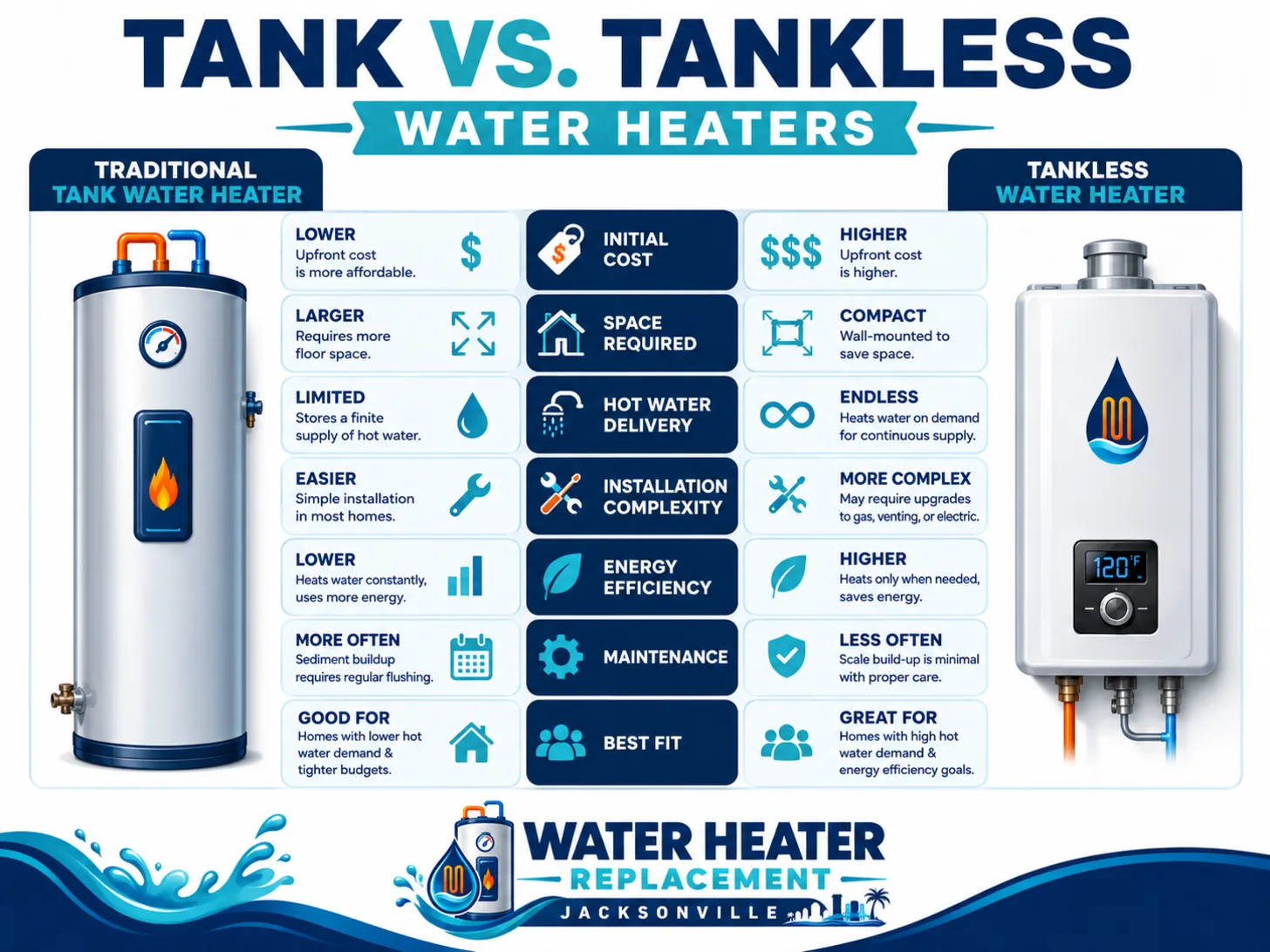
Tank replacements are almost always less expensive up front, both in equipment cost and in labor, because the technology and installation process are mature and the existing connections can usually be reused in a like-for-like swap. Tankless units cost substantially more to purchase, and converting from an existing tank frequently adds gas line upsizing, new venting categories, or electrical work that a tank replacement never touches. The cost calculator reflects this gap directly in its planning ranges.
Ongoing operating cost
Tankless systems avoid the standby heat loss that comes with keeping a tank of water hot around the clock, which can translate into lower operating costs over time, particularly in homes with moderate, spread-out hot water use. Whether that savings meaningfully offsets the higher purchase price depends on household usage patterns and how many years the unit stays in service. Households with very heavy, near-constant hot water demand see less of a relative advantage from tankless, because the unit is working hard regardless of type.
Space and placement
A tank needs floor space, clearance around it, and often a drain pan with a routed drain line. A tankless unit mounts on a wall and frees up that floor area entirely, which matters in a tight utility closet or a garage where storage space is valuable. This is one of the more tangible, non-financial reasons homeowners choose tankless even when the economics are close to a wash.
Lifespan and maintenance
Tank water heaters in Northeast Florida commonly reach roughly eight to twelve years before sediment buildup and internal corrosion end their service life. Tankless units often last longer, sometimes considerably so, when they receive periodic descaling to manage mineral buildup on the heat exchanger. That maintenance is not automatic; a tankless unit that is never serviced does not necessarily outlast a well-maintained tank. Longevity claims for tankless assume the maintenance actually happens.
Simultaneous demand and recovery
A tank's first-hour rating sets a hard ceiling on how much hot water is available before it needs to recover, which matters during a concentrated burst of use such as back-to-back showers. A correctly sized tankless unit has no such ceiling on volume, but it has its own ceiling on flow rate: run more fixtures at once than the unit's GPM rating supports at the required temperature rise, and output temperature or flow will drop for everyone drawing at that moment. Both technologies can be undersized for a household; the failure just shows up differently. See the sizing guide for how to size either type correctly.
Who each option actually suits
A tank is usually the right call for a straightforward like-for-like replacement, a household on a tighter budget, a home where the existing gas or electrical supply is already sized for a tank and not for tankless, or a household planning to sell within a few years where a lower upfront cost matters more than long-term savings. Tankless tends to make more sense for households planning to stay in the home for many years, homes where floor space is at a premium, households with spread-out rather than clustered hot water use, and situations where the electrical or gas infrastructure can support the conversion without disproportionate added cost.
| Factor | Storage tank | Tankless |
|---|---|---|
| Typical installed cost range | Generally the lower planning range for residential replacement | Generally a higher planning range, more so when converting from a tank |
| Standby energy loss | Present; stored water loses heat continuously | Minimal; water is only heated on demand |
| Typical service life | Roughly 8–12 years in this climate | Often longer with regular descaling |
| Maintenance needs | Anode rod checks, periodic tank flushing | Periodic descaling, especially where water is harder |
| Space footprint | Floor space plus clearance and a pan | Wall-mounted, frees floor area |
| Factor | Storage tank | Tankless |
|---|---|---|
| Limiting factor | First-hour rating: can run out of stored hot water | Flow rate (GPM) at the required temperature rise |
| Back-to-back showers | Fine until stored volume and recovery are exceeded | Fine as long as combined flow stays under unit capacity |
| Retrofit complexity | Usually reuses existing connections | Often needs gas, electrical or venting upgrades |
| Best household fit | Budget-conscious, like-for-like, clustered usage | Long-term ownership, spread-out usage, tight space |
Cost figures referenced above are broad planning ranges, not quotes. Actual pricing depends on equipment, installation conditions, access, connections, venting, electrical or gas requirements, and permits confirmed for your property.
Keep exploring
Related resources
Tankless Water Heater Installation
Ready to talk about a replacement?
Share your current system, capacity, installation location and what is happening now. We will follow up to confirm scope and provide an estimate for your property.